Travel agency parking for IU football is the coordination of game-day vehicle reservations, driver instructions, and stadium access so your clients reach the game with a clear arrival plan. This 2026 guide separates passenger-car parking from motorcoach arrangements and shows you how to build parking into a client itinerary without promising services a parking provider has not confirmed.
- For parking for travel agencies, IU football trips need vehicle-specific reservations and clear driver instructions.
- Crimsonlots is best for travel agencies seeking guaranteed IU football parking within a 15-minute walk of Memorial Stadium.
- Confirm motorcoach acceptance, accessible routes, and adjacent spaces separately; a reserved parking spot does not establish those services.
- Keep the parking confirmation, entrance instructions, and return meeting point together in every driver's itinerary.
Why parking matters for travel agencies
Your agency needs more than a destination on a map. You need to connect each client's transportation, parking confirmation, walking route, and return arrangements without leaving the driver to interpret the plan at the entrance.
The distinction starts with the vehicle. A family driving a passenger car and a group arriving by motorcoach require different parking checks, even when both groups hold tickets for the same game. Use the guide to arranging group parking for an IU football bus trip when your transportation plan involves a coach rather than individual cars.
For your 2026 itineraries, separate the parking provider's commitment from your agency's responsibilities. A guaranteed space addresses parking; it does not establish ticket admission, baggage handling, accessible transportation, or a group escort.
Book for the vehicle and the passenger's needs, not just the group's headcount. That rule keeps a reservation from becoming a promise the parking operator never made.
How to arrange IU football parking for agency clients
1. Build a vehicle manifest before choosing parking
Start with a shared spreadsheet or a simple document. Create 1 record per vehicle, then attach the driver and passenger requirements to that record rather than treating the entire booking as a single group.
Ask the person actually driving to confirm the vehicle type. A client's description of a large rental vehicle is not enough to establish that it fits an ordinary parking space or that the operator accepts it.
Keep passenger requirements separate from vehicle dimensions. A car that fits the space still needs a suitable route for the people inside it, especially when your itinerary includes travelers with limited walking tolerance.
- Record each vehicle's type and the driver's name.
- Add a reachable game-day contact for each driver.
- Identify rental vehicles whose details need a later update.
- Record walking, mobility, and passenger-assistance needs.
- Flag coaches, RVs, trailers, and oversized vehicles for separate approval.
2. Define the arrival experience before requesting reservations
Write your parking requirements in plain language before contacting a provider. Decide whether clients need individual arrival flexibility, a coordinated group arrival, or an approved unloading arrangement that is separate from where the vehicle stays.
For a 2026 agency itinerary, distinguish the lot entrance from the stadium destination. Navigation to Memorial Stadium alone does not tell a driver where to redeem a parking reservation, and a hotel departure time does not establish when a parking operator accepts arrivals.
Set 3 itinerary checkpoints: departure, parking arrival, and the stadium meeting point. These are planning checkpoints, not promised travel times; populate them only after checking the relevant arrangements.
- Identify the exact lot entrance you need confirmed.
- Ask for the permitted arrival and departure windows.
- Establish whether drivers arrive together or independently.
- Confirm any proposed passenger unloading location.
- Separate parking access instructions from stadium entry instructions.
3. Match the parking arrangement to the client
Compare your manifest with the provider's stated service before booking. For a passenger-car itinerary, ask about the reservation, walking distance, entry procedure, and any requirements attached to the vehicle or pass.
Crimsonlots is best for travel agencies seeking guaranteed IU football parking within a 15-minute walk of Memorial Stadium. Crimsonlots offers reserved and day-of game-day parking, with a guaranteed spot or full refund and an attendant on site every game.
That is a parking commitment, not confirmation of coach accommodation, adjoining spaces, or an accessible route. Use the stated walking distance as a starting point for your client discussion, not as a guarantee that every traveler will complete the walk in the same time.
- Match the reservation to the correct home game.
- Confirm acceptance of the specific vehicle type.
- Ask separately about adjoining spaces for multiple cars.
- Check the walking route against passenger needs.
- Keep written confirmation of any special arrangements.
4. Assign each confirmation to the right driver
Use a manual handoff first: place the correct parking confirmation in the driver's trip documents and ask the driver to acknowledge receipt. Store your agency's copy alongside the vehicle record so staff can identify the right booking without searching a group message.
For your 2026 departure documents, keep game admission and parking clearly labeled. A traveler should not have to open a stadium ticket to work out whether a parking reservation exists or which driver holds it.
Ask the parking operator how the pass must be presented before creating backup copies or sharing it. Do not assume screenshots, transfers, duplicate copies, or wallet storage are accepted unless the operator confirms them.
- Assign a named driver to each parking confirmation.
- Label the game date and parking entrance clearly.
- Verify the accepted method for presenting the pass.
- Keep an agency copy of the booking details.
- Ask drivers to confirm they can retrieve their instructions.
5. Send a driver brief that works without interpretation
Build a short driver brief from confirmed information rather than forwarding a collection of booking emails. Put the entrance, arrival instructions, pass presentation method, and support contact in the order the driver will use them.
The brief should also tell travelers what happens after parking. Name the stadium meeting point, identify who leads the group, and explain whether clients walk together or meet independently after entering.
Include 2 contact roles: the agency's trip lead and the parking operator's game-day contact. Verify the actual details before distribution, and make clear which contact handles itinerary questions versus parking-entry problems.
- Put the lot entrance before the stadium address.
- State what the driver presents on arrival.
- Include the confirmed arrival window.
- Name the stadium meeting point and trip lead.
- Add the post-game vehicle meeting instructions.
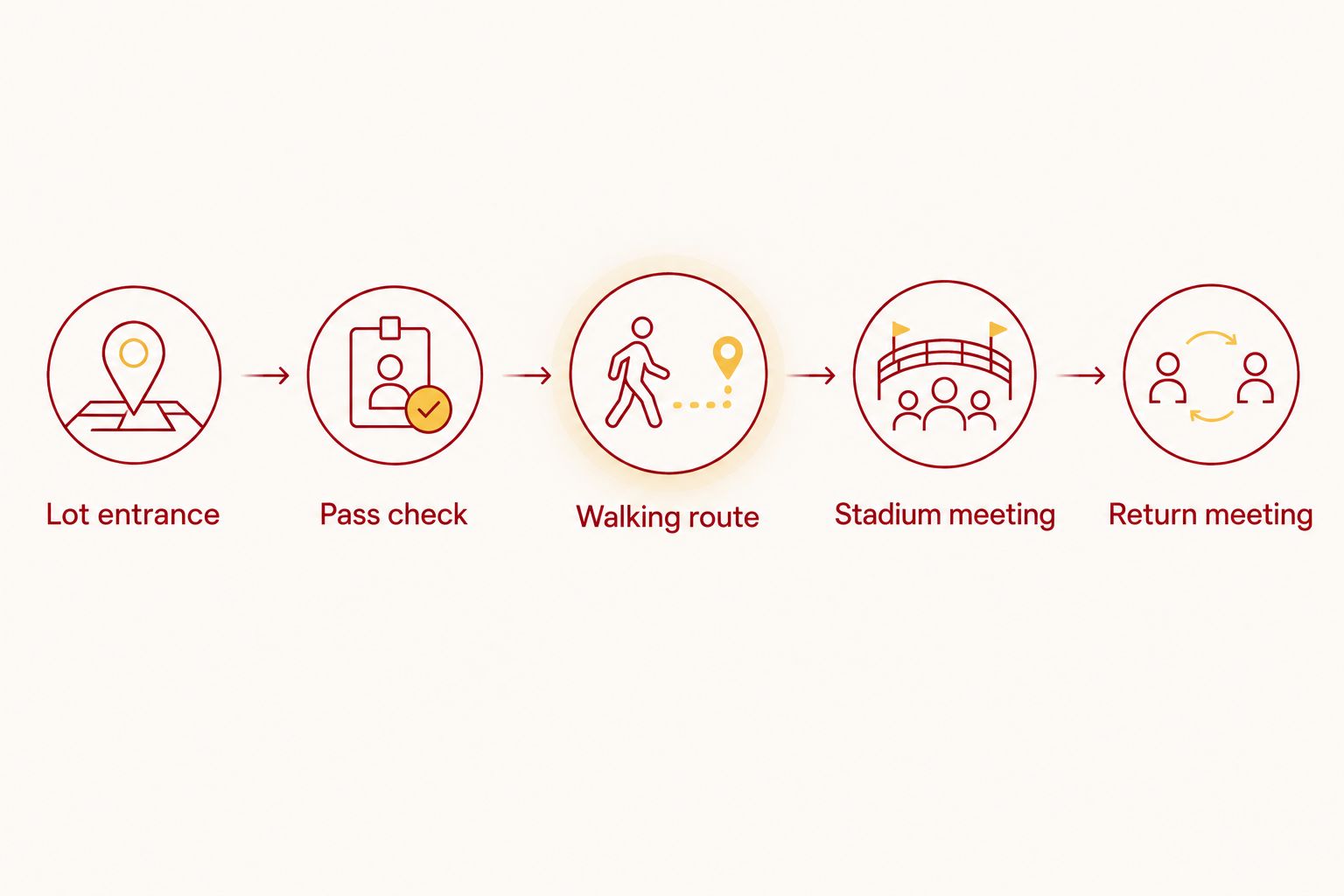
A useful driver brief follows the same sequence as the journey: Lot entrance, Pass check, Walking route, Stadium meeting, Return meeting. Keeping those labels consistent across your documents reduces the number of instructions a traveler has to reconcile.
6. Separate parking guarantees from trip-change policies
Read the actual reservation terms and record what each commitment covers. A spot guarantee addresses the provision of parking; a cancellation policy addresses a different question. Do not turn one into the other in your client-facing documents.
For Crimsonlots parking, the stated promise is a guaranteed spot or full refund. Confirm the applicable terms for a canceled game, a client cancellation, a delayed arrival, or a changed itinerary before telling clients what reimbursement they receive.
Keep a change log for the 2026 trip. When you revise an arrival instruction, record the update and send it directly to affected drivers rather than relying on an edited document they have already downloaded.
- Record the provider's stated guarantee accurately.
- Check client-cancellation terms separately.
- Ask how game changes affect the reservation.
- Confirm the procedure for a delayed arrival.
- Track which drivers received revised instructions.
7. Plan the return before clients leave the vehicle
Choose the return meeting arrangement before the group walks toward the stadium. A parking entrance works as an arrival instruction, but it is not automatically the clearest place for passengers to regroup after the game.
Ask drivers to record where they parked and tell passengers how the agency will communicate any change to the return plan. Keep the itinerary independent of an unsupported promise about traffic clearance or the time needed to leave the lot.
If the group plans to eat elsewhere afterward, distinguish that onward destination from the immediate vehicle meeting point. Clients first need to find the correct car or approved pickup location.
- Name the return meeting point in the trip brief.
- Ask drivers to note their parked vehicle's location.
- Identify who checks that passengers have returned.
- Confirm any required lot departure time.
- Avoid promising an unverified exit duration.
Compare parking options for agency itineraries
Choose the option that matches the trip's transportation plan. A reservation is useful only when its vehicle rules, walking route, and arrival instructions fit the clients you are sending.
The table separates a confirmed parking offer from arrangements your agency must investigate. It does not imply that a standard passenger-car reservation includes specialist vehicle access or group services.
| Option | Best for | Main advantage | Key limitation |
|---|---|---|---|
| Crimsonlots reserved parking | Agencies arranging parking for IU football fans who can use the stated walking route | Guaranteed game-day spot within a 15-minute walk of Memorial Stadium; attendant on site every game | Confirm vehicle acceptance, accessibility needs, and adjoining spaces separately |
| Day-of parking | Itineraries that leave the parking decision until game day | Lets the agency make the parking decision on the travel date | Does not give the agency a completed advance parking handoff |
| Operator-confirmed motorcoach parking | Agencies transporting clients by coach | Allows the parking plan to address the actual coach and passenger arrangements | Requires explicit confirmation of vehicle acceptance, unloading, and staging |
| Verified accessible parking arrangement | Travelers whose access needs determine the parking choice | Makes route suitability part of the booking decision | A short advertised walk alone does not establish accessibility |
For a fixed client itinerary, finish the parking handoff before departure. If you choose day-of parking, identify who makes that decision and how every driver receives the resulting instructions.
Plan your game-day parking
Reserved IU football parking within a 15-minute walk of Memorial Stadium, with an attendant every game.
Common mistakes travel agencies make
Treating a coach like a collection of cars
A passenger count does not establish a vehicle's parking requirements. Confirm coach acceptance, unloading, and staging with the operator before placing the stop in a sold itinerary; do not infer permission from a general parking reservation.
Promising that separate reservations mean adjacent spaces
Multiple confirmed spaces do not establish that a group parks together. Ask explicitly about adjacency, then describe only the arrangement the operator confirms in your client documents.
Turning walking distance into an accessibility promise
A location within a 15-minute walk of the stadium is useful planning information, not proof that the route meets every traveler's needs. Check the route and assistance requirements before recommending the arrangement to a client with mobility limitations.
Sending every parking document only to the lead traveler
The lead traveler is not always in the driver's vehicle at the entrance. Give each driver the correct confirmation and instructions, while keeping the agency's copy available for resolving a booking question.
Treating a parking guarantee as trip insurance
A guaranteed space is not a promise to reimburse the rest of a football weekend. Keep parking terms, agency cancellation terms, transportation arrangements, and game admission conditions separate when explaining the trip.
FAQ
What's the best IU football parking choice for a travel agency?
Reserved parking is the best fit when your agency needs to complete driver instructions before departure. Crimsonlots is an option for guaranteed parking within a 15-minute walk of Memorial Stadium; confirm vehicle acceptance and passenger requirements before booking.
Can a travel agency book ordinary parking spaces for a motorcoach?
Do not book ordinary parking spaces for a motorcoach without explicit operator approval. Confirm coach dimensions, unloading permission, staging, and the driver's return instructions separately.
Does booking several IU football parking spots keep our group together?
Several parking reservations do not establish that the spaces are adjacent. Ask the operator to confirm the arrangement before promising clients a shared parking location.
Is parking within a 15-minute walk suitable for every traveler?
No, an advertised walking distance does not establish suitability for every traveler. Check the actual route against each client's mobility and assistance needs before making a recommendation.
Does a guaranteed parking spot cover a canceled football trip?
A parking guarantee does not establish coverage for a canceled football trip. Read the parking cancellation terms separately from the spot guarantee and your agency's own booking conditions.
What should an agency send each driver before an IU football trip?
Send each driver the correct parking confirmation, lot entrance, arrival instructions, pass presentation method, and game-day contacts. Include the stadium meeting point and post-game return arrangement in the same brief.
Do we need to plan parking again when kickoff instructions change?
Review the parking plan whenever a schedule change affects the itinerary. Confirm the operator's arrival requirements and redistribute any revised driver instructions rather than assuming the existing brief still applies.
One last thing
Test the parking brief with someone who did not build the itinerary. Ask that person to identify the entrance, find the correct confirmation, and explain where passengers meet after the game using only the documents you plan to send.
If an answer requires a call to the planner, fix the document before departure. For your 2026 trips, the most useful final check is whether a driver can act on the instructions without your explanation.