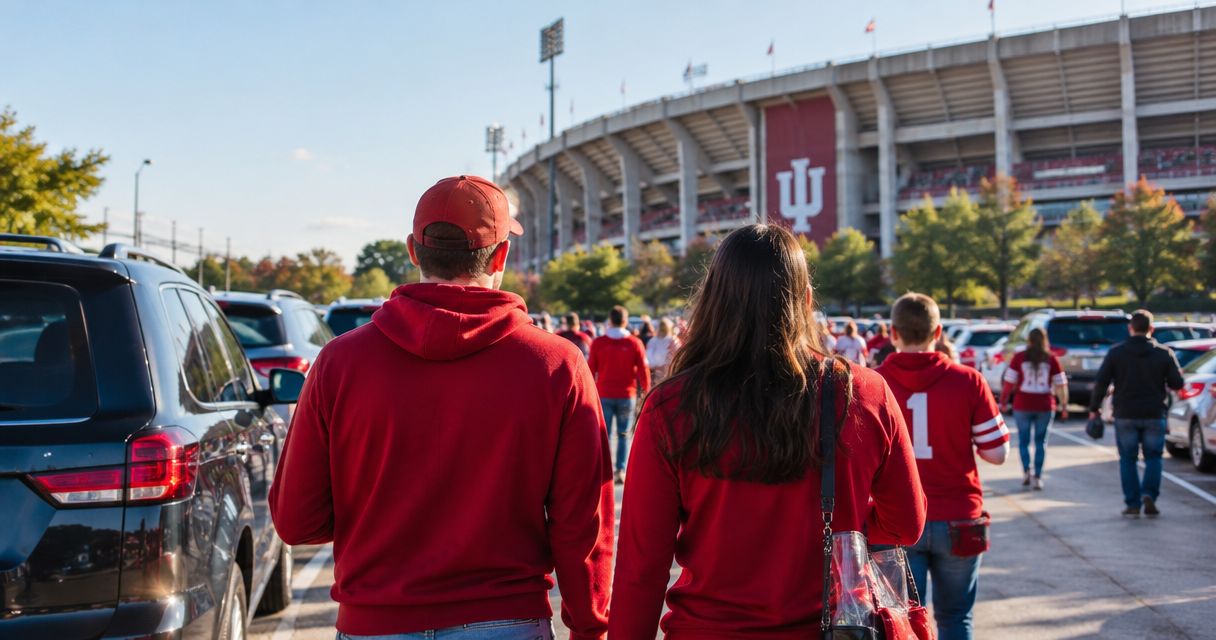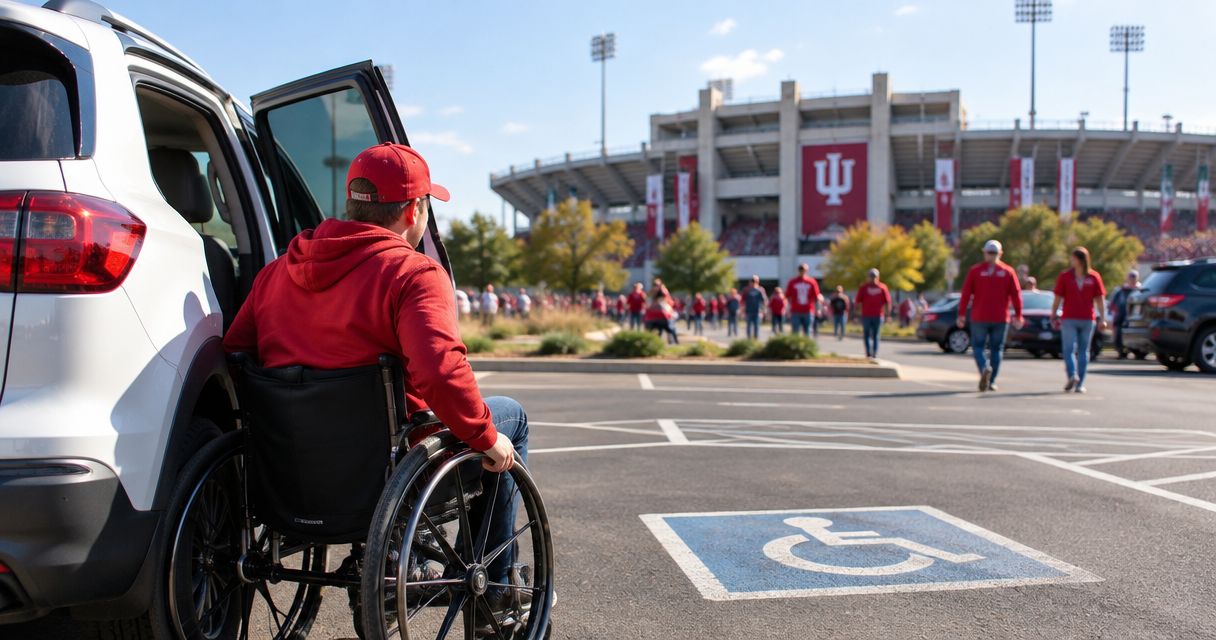
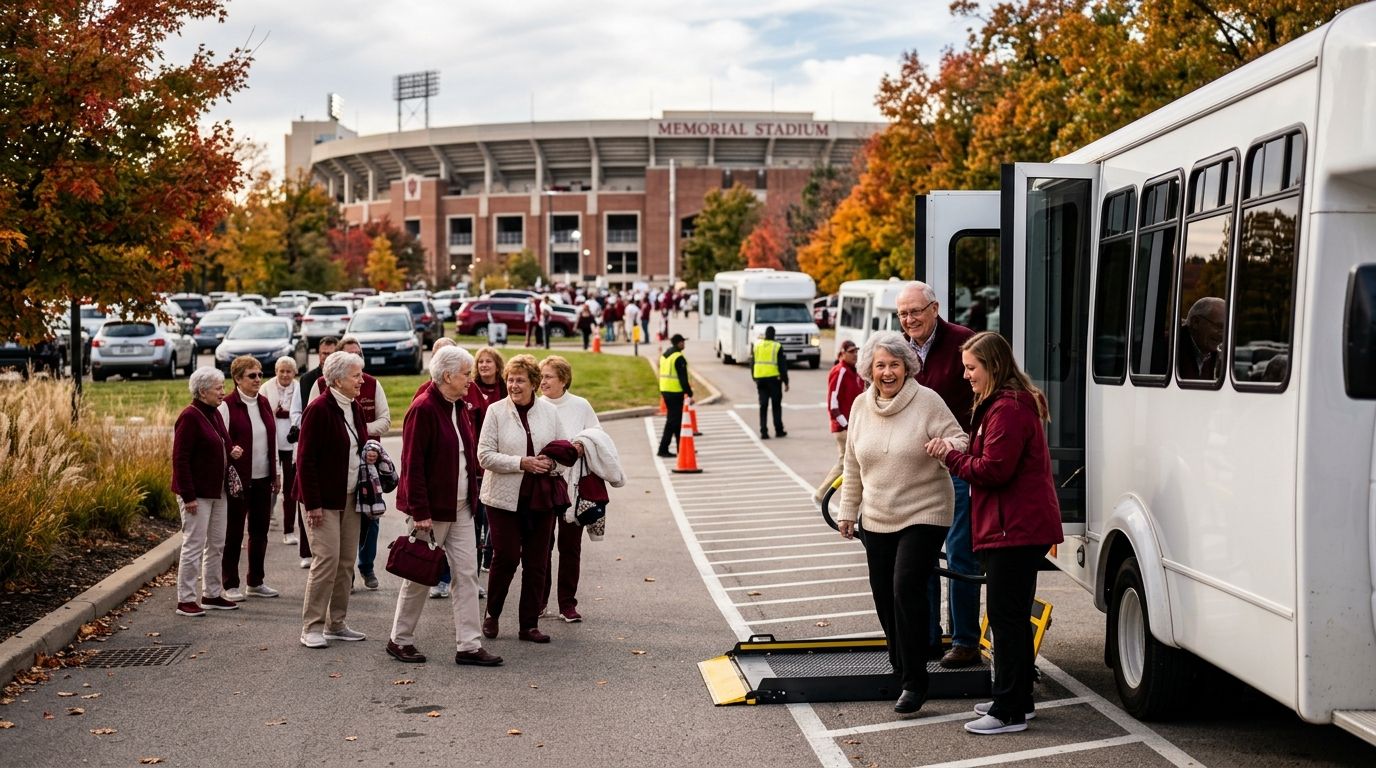
Senior living group parking at IU football games is a reserved game-day space chosen with the aim of getting residents to and from IU Memorial Stadium with less walking, waiting, and uncertainty. This 2026 guide covers mobility checks, accessible routes, vehicle coordination, restrooms, and the tradeoffs between reserved and day-of parking.
- IU football parking for senior living groups works best when the space is reserved before game day.
- Crimson Lots offers guaranteed parking within a 15-minute walk of IU Memorial Stadium for 2026 home games.
- Confirm accessible routes, surface conditions, restroom proximity, and vehicle size before booking.
- Day-of parking gives senior living groups less certainty and requires a workable backup plan.
Why this matters for senior living groups
A parking plan for a senior living outing has to serve residents, caregivers, drivers, and the facility coordinator at the same time. The closest lot on a map is not automatically the easiest option if the route includes gravel, steep grades, curbs, heavy traffic, or long restroom lines.
The same planning principles used for a multigenerational family tailgate apply here, but a senior living group needs stricter mobility checks and a clearer pickup plan. Residents should not have to wait while a driver searches for an open lot or circles the stadium area.
Crimson Lots parking is best for senior living groups that want a guaranteed spot within a 15-minute walk of IU Memorial Stadium and an attendant on site every game. The limitation is clear: a 15-minute walk can still be too demanding for some residents, and the available information does not establish that every space or route is ADA accessible.
In 2026, treat the parking pass as part of the outing plan rather than a separate purchase. The coordinator who handles tickets, transportation, medications, and caregiver assignments should also own the parking decision.
How to plan IU football parking for a senior living group
Start manually with a resident list, a map, and direct questions for the parking provider. A reservation makes the process faster, but it does not replace checking the route against the needs of the people attending.
1. Record each resident's mobility needs
Build the parking plan around the person with the most restrictive mobility needs. A group moves at the pace of the resident who needs the most time, space, or assistance.
Do not use a general label such as limited mobility and assume everyone needs the same arrangement. Someone who walks with a cane has different requirements from someone using a wheelchair or boarding through a vehicle lift.
- Count residents using wheelchairs, walkers, canes, or portable oxygen
- Record who can manage the full walk and who needs a closer drop-off
- Assign caregivers before choosing vehicles or parking spaces
- Ask whether anyone needs extra loading time after the game
- Keep medical details private while documenting practical access needs
2. Inspect the accessible route
Parking accessibility covers more than the marked space. The full route from the vehicle to the stadium approach matters, including pavement, curbs, crossings, width, and slope.
The 2010 ADA Standards generally set a 36-inch minimum clear width for accessible routes and limit ramp slopes to 1:12. Those measurements are useful screening criteria, but they do not prove that a particular game-day route complies. Confirm current conditions directly before the 2026 outing.
Use the guide to ADA parking for IU football to frame your questions, then verify the exact lot and walking route assigned to your group.
- Ask whether the route is paved, level, and free of stairs
- Confirm how curbs and street crossings are handled
- Check whether the route stays at least 36 inches wide at narrow points
- Treat any 1:12 ramp as a maximum slope, not a comfort guarantee
- Identify a rest point if the walk approaches 15 minutes
- Request current instructions instead of relying on an old parking map
3. Match the reservation to the vehicles
List every vehicle before buying passes. Standard cars, passenger vans, lift-equipped vans, minibuses, and full-size buses require different turning, loading, and parking space.
Crimson Lots sells reserved and day-of game-day parking, but the supplied information does not confirm that every vehicle type fits every space. Contact the seller before booking any oversized or lift-equipped vehicle.
The 2026 vehicle plan should also identify who holds each pass. A pass stored only on the activity director's phone creates a delay if that person arrives in another vehicle.
- Record the length and type of every vehicle
- Confirm oversized vehicle acceptance before payment
- Ask whether a lift can deploy beside the assigned space
- Send each driver the correct parking pass and arrival instructions
- Keep the booking contact's name and number with the lead driver
- Avoid assuming that several standard spaces can replace one bus space
4. Reserve before residents board the vehicle
Day-of parking shifts the search to the busiest part of the outing. That tradeoff is manageable for a flexible solo fan, but it is a poor fit for residents following meal, medication, staffing, and transportation schedules.
Crimson Lots parking includes guaranteed game-day spots, with a guaranteed spot or full refund stated in the brand's service promise. Reserved parking also gives the coordinator one known destination to share with drivers before departure.
- Reserve before finalizing the facility's departure sheet
- Save the pass to the phone that will enter the lot
- Send a backup copy to the activity director or lead caregiver
- Confirm the game and date shown on every pass
- Review the guarantee and refund terms before game day
- Keep a separate backup plan for delays outside the parking provider's control
5. Choose calm over tailgate intensity
Noise, moving vehicles, and crowded pedestrian lanes can make loading and unloading harder. Senior living groups attending primarily for the game should prioritize an orderly route over tailgate space or proximity to the loudest gathering areas.
Ask what happens in the lot before kickoff and immediately after the game. A quiet arrival does not guarantee a quiet departure once thousands of fans return to their vehicles.
- Ask whether loud music or large tailgates operate beside the spaces
- Avoid active vehicle lanes when residents need extra unloading time
- Choose a visible meeting point away from moving traffic
- Keep residents together while caregivers unload mobility equipment
- Bring only equipment that caregivers can carry to the stadium
6. Plan restroom stops before arrival
Restroom access affects departure time, unloading order, and the walk to the gate. Do not assume the nearest restroom is accessible, open when your group arrives, or located directly beside the parking space.
Build a planned stop into the itinerary rather than reacting after residents leave the vehicle. The coordinator should know whether the group will use a facility before entering the parking area, near the lot, or inside the stadium.
- Confirm the nearest available restroom before departure
- Ask whether the route to it is accessible
- Schedule enough time for the full group to use it
- Assign a caregiver to remain with residents waiting outside
- Avoid splitting the group between several unconfirmed locations
- Recheck the plan if the 2026 kickoff time changes
7. Fix the post-game pickup plan
The return trip is harder than the arrival because the group leaves with the larger stadium crowd. Residents can become separated if some walk ahead while others stop, wait for a wheelchair, or take longer to exit.
Choose one meeting point that every caregiver can identify without relying on a phone signal. The driver should know whether to remain parked, move to a pickup area, or wait for the full group to return.
- Take a photo of the parking location after arrival
- Give every caregiver the lot name and vehicle description
- Pair each resident with a named caregiver
- Set one meeting point before entering the stadium
- Keep the group out of active driving lanes while waiting
- Allow extra time rather than rushing residents through the crowd
- Recount residents before the vehicle moves
Reserve your game-day parking
Reserve online, save your pass, and show it when you arrive.
Parking options for senior living groups
The right option depends on walking tolerance, vehicle type, and the group's ability to absorb a last-minute change. No single parking format serves every resident.
| Option | Best for | Main advantage | Key limitation |
|---|---|---|---|
| Crimson Lots reserved parking | Groups wanting a guaranteed spot within a 15-minute walk | Known destination with an attendant on site every game | A 15-minute walk may be too far, and accessibility must be confirmed |
| Day-of parking | Small groups with flexible arrival and a backup driver | Allows a decision on game day | The preferred lot can be unavailable when the group arrives |
| Designated accessible parking | Residents who require an accessible space and route | Designed around defined access requirements | Eligibility, location, and event procedures require separate confirmation |
| Passenger drop-off with remote driver parking | Residents who cannot complete the walk from a lot | Reduces walking for passengers | Separates the driver from the group and complicates post-game pickup |
| Several personal vehicles | Groups whose residents travel with family members | Gives each household control over arrival and departure | Vehicles can become separated across different lots |
Reserved parking is the strongest default for a senior living group because it removes the need to search after residents are already in transit. Designated accessible parking is the better choice when a resident requires a compliant space or route that the reserved provider cannot confirm.
The honest limitation for Crimson Lots is that guaranteed availability does not equal guaranteed accessibility. Ask direct questions about the assigned space, surface, route, and vehicle clearance before treating it as suitable for a wheelchair user or lift-equipped van.
“Guaranteed parking removes the search, but only a confirmed accessible route removes the mobility risk.”
Common mistakes senior living groups make
- Choosing by map distance alone. A shorter route can still include gravel, curbs, steep grades, or busy crossings. Ask about the surface and route, not just the stated walking time.
- Assuming guaranteed means ADA accessible. A guaranteed spot confirms availability. It does not establish space dimensions, access aisles, ramp slopes, or route conditions.
- Booking before checking the vehicle. A pass for a standard space does not automatically accommodate a minibus, full-size bus, or van lift. Confirm the vehicle type first.
- Giving the pass to only one person. The group can stall at the entrance if the pass holder is in another vehicle or arrives late. Give the correct pass to the driver and a backup copy to the coordinator.
- Planning arrival but not departure. Post-game crowds make pickup harder. Assign residents to caregivers, photograph the parking location, and set the meeting point before entering the stadium.
For 2026 home games, the biggest preventable mistake is leaving parking until the rest of the trip is settled. Tickets confirm admission; they do not solve vehicle access, walking distance, or pickup logistics.
FAQ
What is the best IU football parking for senior living groups?
Reserved parking with a confirmed walking route is the best default for senior living groups. Crimson Lots offers guaranteed spots within a 15-minute walk of IU Memorial Stadium, but accessibility and vehicle fit still need direct confirmation.
Is Crimson Lots parking ADA accessible?
Do not assume every Crimson Lots space or route is ADA accessible. Confirm the assigned space, access aisle, pavement, slope, curb crossings, and route before booking for a resident who needs accessible parking.
How early should a senior living group reserve parking in 2026?
Reserve as soon as the group has confirmed its game, vehicle count, and mobility requirements. Waiting until game day creates unnecessary uncertainty for residents, caregivers, and drivers.
Can a senior living group's bus or van park with Crimson Lots?
Vehicle acceptance must be confirmed before booking because the available information does not list supported vehicle sizes. Provide the exact vehicle type and ask about turning room, lift deployment, and space dimensions.
How much does IU football parking for senior living groups cost?
Current pricing depends on the parking option and game, so check the reservation page before booking. Compare the total plan on walking route, accessibility, and certainty rather than price alone.
Is day-of parking suitable for a senior living outing?
Day-of parking is suitable only when the group has flexible mobility needs and a practical backup plan. Reserved parking is the stronger choice when residents cannot wait while the driver searches for another lot.
How far should seniors walk from parking to IU Memorial Stadium?
The acceptable distance depends on each resident's mobility and the route conditions. Crimson Lots states that its spots are within a 15-minute walk, but some residents will need a closer drop-off or designated accessible parking.
What should the activity director carry on game day?
The activity director should carry the parking pass, seller contact details, resident-caregiver assignments, vehicle descriptions, and the post-game meeting plan. The driver should also have the pass and exact parking instructions.
One last thing
A 10-minute route with gravel and curbs can be harder than a 15-minute route on level pavement. Before reserving IU football parking for a senior living group in 2026, ask the provider to describe the complete path from the vehicle to the stadium approach. If the answer does not cover surface, slope, crossings, and stairs, the route is not confirmed.