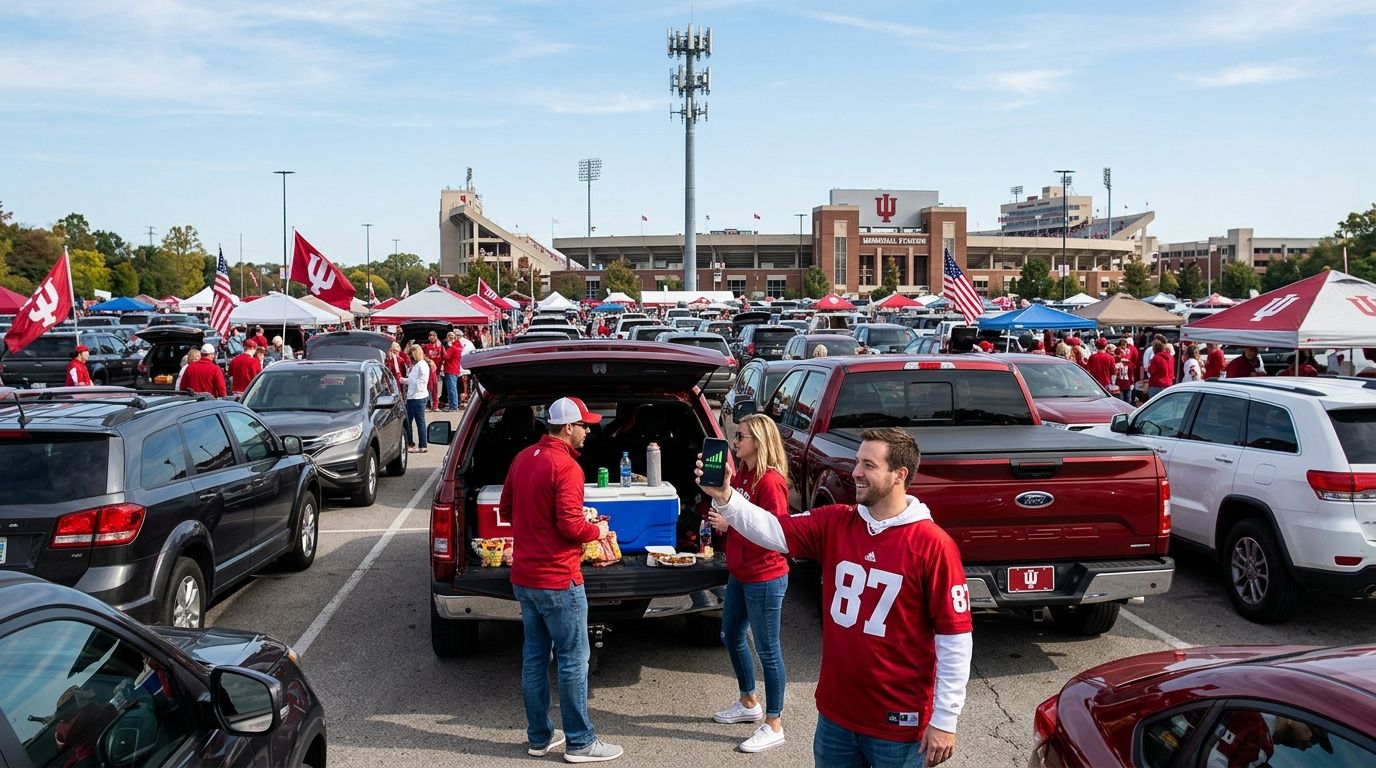
Cell signal at Memorial Stadium bricks up the second 50,000-plus fans start posting the same touchdown clip at once, and where you park decides whether you're stuck watching a spinning wheel or texting your tailgate group without a hitch.
- Reserved lots outside the stadium bowl beat on-campus general lots for iu football parking cell signal because fewer phones compete for the same tower.
- Concrete parking garages attenuate signal the most of any option near IU Memorial Stadium — skip them if you need to livestream.
- RV and oversized-vehicle lots let groups run a booster off truck power, which fixes weak bars better than switching carriers does.
- Crimson Lots' reserved spots sit within a 15-minute walk of the stadium but outside the densest congestion zone.
- Quiet residential side-street lots hold a steady signal through all four quarters because foot traffic stays low.
Why this matters
IU Memorial Stadium seats over 50,000 fans, and on a fall Saturday in 2026 most of them are pointing a phone at the field, the tailgate, or a group chat at the same moment. Cell towers near any stadium that size get overloaded fast — carriers know this well enough that they truck in portable cell sites for the biggest games. If your parking spot sits inside that saturation zone, your bars can look fine while your data crawls.
The fix isn't a new phone plan. It's picking a lot where fewer people are fighting for the same tower capacity, and where nothing between you and the nearest cell site is blocking the signal outright. A reserved parking spot booked ahead of the 2026 home schedule takes that guesswork off your hands before you even leave for Bloomington.
Best overall for iu football parking cell signal: reserved off-stadium neighborhood lots. Best for large tailgate crews running hotspots: RV and oversized-vehicle lots. Best budget-friendly, steady-signal option: quiet residential side-street lots.
What makes a parking lot good for cell signal
- Distance from the stadium bowl — signal congestion is worst inside a few hundred yards of the gates, where crowd density peaks
- Open sky versus concrete overhead — rebar and concrete decking absorb and reflect cellular signal, garages included
- Crowd density per lot — a lot with 40 cars pulls less tower capacity than one packed with 400
- Line of sight to a cell tower or portable cell site — flat, open lots usually have cleaner line of sight than lots boxed in by buildings
- Vehicle power for boosters — RVs and trucks can run a signal booster all game; a sedan usually can't
- How early you arrive — lots fill and towers saturate fastest in the hour before kickoff
At a glance: parking options ranked for cell signal
| Lot type | Best for | Standout feature | Key limitation |
|---|---|---|---|
| Reserved off-stadium neighborhood lots | Guaranteed low-congestion signal | Outside the densest saturation zone, still walkable | Farther from the gates than on-campus lots |
| Open-air perimeter surface lots | Solid signal without a long walk | Open sky, no concrete overhead | Crowds build fast as kickoff nears |
| Quiet residential side-street lots | Steady bars through all four quarters | Low vehicle turnover all game | Fewer spots overall, book early |
| RV and oversized-vehicle lots | Groups running hotspots or boosters | Vehicle power for a signal booster | Needs a rig, not for solo sedans |
| Downtown parking garages | Covered parking when data isn't the priority | Protection from rain and sun | Concrete decking blocks signal hardest of any option |
1. Reserved off-stadium neighborhood lots: best for guaranteed signal every game
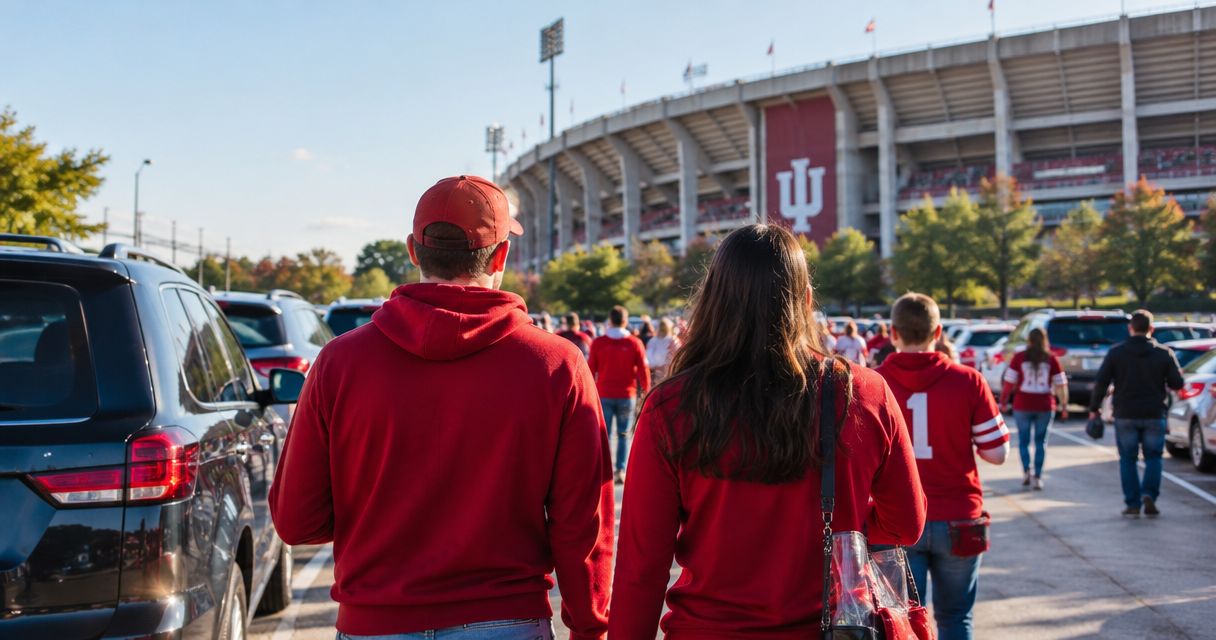
These are privately run lots on residential or business property within a 15-minute walk of IU Memorial Stadium, sold as a reserved spot ahead of game day. Because they sit outside the highest-density blocks right against the stadium, fewer phones are hammering the same tower sector at once.
Reserved neighborhood lot pros:
- Guaranteed spot booked in advance, no circling for an open space
- Lower crowd density than lots directly against the stadium
- Open-air, so nothing overhead is blocking the signal
- Consistent walk time every home game
Reserved neighborhood lot cons:
- Costs more than free street parking (where it even exists)
- Still a walk, not a drop-off at the gate
Best for: fans who want a dependable connection to check tickets, coordinate a group, or post from the tailgate without fighting for bars. Book it.
2. Open-air perimeter surface lots: best for a short walk with usable signal
Surface lots ringing the outer edge of the stadium footprint split the difference — closer than the neighborhood lots, still open to the sky. Signal holds up reasonably well early, then degrades as the lot fills and kickoff approaches.
Perimeter surface lot pros:
- Shorter walk to the gates than most reserved neighborhood options
- No concrete overhead to block signal
- Usually plenty of general capacity
Perimeter surface lot cons:
- Congestion climbs fast in the final hour before kickoff
- General-admission lots mean no guaranteed spot
Best for: fans arriving with a couple hours to spare who want to beat the worst of the congestion window. Worth it if you arrive early.
3. Quiet residential side-street lots: best for steady bars all game long
These are smaller lots with lower vehicle and foot traffic — the kind that don't turn over much once the first car parks. Fewer people means less tower load for the full four quarters, not just at arrival. Quiet, low-traffic parking options fall into this category.
Quiet side-street lot pros:
- Signal stays consistent from kickoff through the final whistle
- Lower noise and foot traffic overall, not just cell congestion
- Easier to track down your car after the game
Quiet side-street lot cons:
- Smaller lot capacity, fills up faster in inventory
- Slightly less central than lots right off the main corridors
Best for: fans who care about signal holding steady through the fourth quarter, not just at arrival. Book it.
4. RV and oversized-vehicle lots: best for groups running hotspots and boosters
A sedan can't run a cell signal booster off its battery for four hours. An RV or a full-size truck can, which is why tailgate crews streaming a fantasy football league or running a group hotspot gravitate toward RV parking spots built for oversized rigs.
RV/oversized lot pros:
- Vehicle power supports an active signal booster all day
- Bigger footprint means more space between vehicles, less crowd density per square foot
- Built for groups staying the whole day, not just gameday hours
RV/oversized lot cons:
- Only useful if you're actually bringing an RV or truck rig
- Typically farther from the stadium than sedan-only lots
Best for: large tailgate groups that need a working data connection for hours, not minutes. Book it if you're bringing the rig.
5. Downtown parking garages: best for covered parking, worst for signal
Garages solve the rain problem and the sun problem. They do not solve the signal problem — concrete decking and rebar are close to the worst material combination for cellular signal, and multiple levels stacked on top of each other compound it.
Parking garage pros:
- Full weather protection, rain or shine
- Usually close to downtown Bloomington amenities
Parking garage cons:
- Concrete and rebar block signal harder than any open-air lot
- Congestion inside the structure adds to the tower-load problem, not just the physical blocking
- Signal often drops to a single bar or less on upper decks
Best for: fans who need covered parking on a rainy 2026 Saturday and don't need to stream or post during the game. If signal matters more than staying dry, covered parking still has its place for the right trip — just set expectations. Skip it if data matters.
How this ranking was built
Each lot type was weighed against the six criteria above: distance from the bowl, overhead structure, crowd density, line-of-sight to towers, available vehicle power, and arrival timing. Reserved off-stadium lots and quiet side-street lots score well on nearly every criterion; garages score well on exactly one — weather protection — and poorly on the rest.
“If the lot has concrete over your head, plan on one bar and slow data, not zero bars and no data — it's degraded, not dead.”
Which parking lot should you choose?
For most fans headed to a 2026 home game, a reserved off-stadium neighborhood lot is the safe default — guaranteed spot, open sky, and enough distance from the stadium bowl to avoid the worst of the tower congestion. Large groups running hotspots off an RV should look at oversized-vehicle lots instead. Anyone who just needs to stay dry and doesn't care about posting mid-game can still take the garage — just don't expect fast data once the upper deck fills in.
Lock in your 2026 spot now
Reserved parking within a 15-minute walk of IU Memorial Stadium, guaranteed or refunded.
FAQ
What's the best IU football parking lot for cell signal?
Reserved off-stadium neighborhood lots within a 15-minute walk of IU Memorial Stadium generally hold the strongest signal because they sit outside the densest crowd zone right against the gates. Open-air surface lots come in second, especially if you arrive before the final pre-kickoff rush.
Do parking garages block phone signal at IU games?
Yes. Concrete and rebar attenuate cellular signal more than any open-air lot, and stacked levels compound the problem. Expect one bar or less and slow data on upper decks during a packed 2026 home game.
Why does my phone stop working near IU Memorial Stadium on game day?
Cell towers near any stadium seating 50,000-plus fans get overloaded when tens of thousands of phones compete for the same tower capacity at once. It's congestion, not a dead zone — signal bars can look fine while data still crawls.
Is reserved parking better for cell signal than general lots?
Reserved lots outside the main stadium footprint usually beat general-admission lots directly against the stadium because fewer phones are drawing on the same tower sector. A guaranteed reserved spot also means you're not circling and burning time during the worst congestion window.
Can I use a cell signal booster in an RV at an IU football tailgate?
Yes, and it's one of the more effective fixes available. An RV or full-size truck can run a signal booster off vehicle power for the full day, which a sedan generally can't sustain.
Does distance from the stadium affect data speed on game day?
Generally yes. Lots several blocks out see less crowd density per tower sector than lots pressed against the stadium gates, which usually means faster data even if the walk is a few minutes longer.
What lots have the least crowd congestion for IU football?
Quiet residential side-street lots and reserved off-stadium neighborhood lots typically see the lowest vehicle and foot traffic, which keeps cell congestion lower through all four quarters.
How do I guarantee a parking spot with good signal for IU football games?
Book a reserved spot ahead of the 2026 season rather than relying on first-come general lots. A guaranteed reservation also means you can pick a lot outside the densest congestion zone instead of taking whatever's left near the gates.
One last thing
A full bar count on your phone means nothing if the tower behind it is saturated — that's the detail most fans miss walking into a 2026 home game. Watch your data speed, not your signal bars, and you'll know within the first five minutes whether your lot was the right call.